

Compute DCSC’s TXND: the number of unusually hot days#
Example notebook that runs icclim.
The example calculates the number of unusually hot days (TXND indicator from DCSC) for the dataset chosen by the user on C4I.
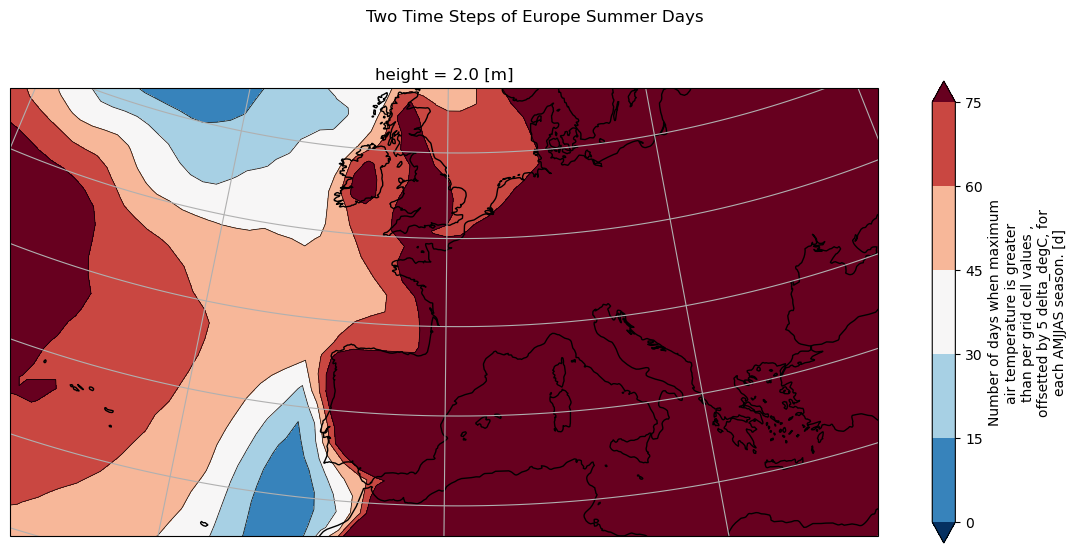
./data folder for model CMCC and for one member r1i1p1f1..metalink file can be dowloaded with tools such as aria2 or a browser plugin such as DownThemAll! If you wish to use a different dataset, you can use the climate 4 impact portal to search and select the data you wish to use and a metalink file to the ESGF data will be provided.The data is read using xarray and a plot of the time series over a specific region is generated, as well as an average spatial map. Several output types examples are shown.
To keep this example fast to run, the following period is considered: 2015-01-01 to 2019-12-31, and plots are shown over European region.
Installation and preparation of the needed modules#
[1]:
from pathlib import Path

import cartopy.crs as ccrs
import matplotlib.pyplot as plt
import numpy as np
import xarray as xr
from xclim.core.calendar import select_time

import icclim
from icclim.frequency import FrequencyRegistry
python:  3.11.7 | packaged by conda-forge | (main, Dec 15 2023, 08:38:37) [GCC 12.3.0]
numpy:  1.26.4
xarray:  2024.2.0
pandas:  2.2.1
icclim:  7.0.0
cftime:  1.6.3
xclim:  0.48.0
Specification of the parameters#
[2]:
DATA_DIR = Path("./data")
out_f = "txnd_icclim.nc"
[3]:
historical_files = [str(f) for f in DATA_DIR.glob("tas*CMCC*historical*.nc")]
sorted(historical_files)
[3]:
['data/tas_day_CMCC-ESM2_historical_r1i1p1f1_gn_18500101-18741231.nc',
 'data/tas_day_CMCC-ESM2_historical_r1i1p1f1_gn_18750101-18991231.nc',
 'data/tas_day_CMCC-ESM2_historical_r1i1p1f1_gn_19000101-19241231.nc',
 'data/tas_day_CMCC-ESM2_historical_r1i1p1f1_gn_19250101-19491231.nc',
 'data/tas_day_CMCC-ESM2_historical_r1i1p1f1_gn_19500101-19741231.nc',
 'data/tas_day_CMCC-ESM2_historical_r1i1p1f1_gn_19750101-19991231.nc',
 'data/tas_day_CMCC-ESM2_historical_r1i1p1f1_gn_20000101-20141231.nc']
[4]:
studied_files = [str(f) for f in DATA_DIR.glob("tas*CMCC*ssp585*.nc")]
sorted(studied_files)
[4]:
['data/tas_day_CMCC-ESM2_ssp585_r1i1p1f1_gn_20150101-20391231.nc',
 'data/tas_day_CMCC-ESM2_ssp585_r1i1p1f1_gn_20400101-20641231.nc',
 'data/tas_day_CMCC-ESM2_ssp585_r1i1p1f1_gn_20650101-20891231.nc',
 'data/tas_day_CMCC-ESM2_ssp585_r1i1p1f1_gn_20900101-21001231.nc']
Build NormaL#
normal, from April to September included.lat, lon couple, the values will be the mean of temperature of the summers within the reference periode.select_time to filter the summer months.ℹ️ Alternatively, the normal can be saved in a netCDF file and the path to this file can be used in
normalparameter oficclim.dcsc.txndfunction.
[5]:
historical_tas = xr.open_mfdataset(historical_files).tas
filtered_tas = select_time(
    historical_tas, month=FrequencyRegistry.AMJJAS.indexer["month"], drop=True
)
normal = filtered_tas.mean(dim="time", keep_attrs=True)
normal
[5]:
<xarray.DataArray 'tas' (lat: 192, lon: 288)> Size: 221kB
dask.array<mean_agg-aggregate, shape=(192, 288), dtype=float32, chunksize=(192, 288), chunktype=numpy.ndarray>
Coordinates:
  * lat      (lat) float64 2kB -90.0 -89.06 -88.12 -87.17 ... 88.12 89.06 90.0
  * lon      (lon) float64 2kB 0.0 1.25 2.5 3.75 5.0 ... 355.0 356.2 357.5 358.8
    height   float64 8B 2.0
Attributes:
    standard_name:  air_temperature
    long_name:      Near-Surface Air Temperature
    comment:        near-surface (usually, 2 meter) air temperature
    units:          K
    original_name:  TREFHT
    cell_methods:   area: time: mean
    cell_measures:  area: areacella
history: 2020-12-21T16:22:42Z altered by CMOR: Treated scalar dime...Compute TXND index#
Usually TXND is computed on the maximum daily temperature (tasmax), but here we show that using var_name we can force icclim to use a different variable to compute indices, as long as its units is compatible.
[6]:
icclim.dcsc.txnd(
    in_files=studied_files[0:1],
    normal=normal,
    var_name="tas",
    slice_mode=FrequencyRegistry.AMJJAS,
    out_file=out_f,
    logs_verbosity="SILENT",
)
/home/bzah/workspace/cerfacs/icclim/src/icclim/_core/generic/indicator.py:534: UserWarning: Unable to infer the frequency of the time series. To mute this, set xclim's option data_validation='log'.
  check_freq(da, src_freq, strict=True)
/home/bzah/micromamba/envs/icclim-dev/lib/python3.11/site-packages/xclim/core/cfchecks.py:42: UserWarning: Variable does not have a `cell_methods` attribute.
  _check_cell_methods(
/home/bzah/micromamba/envs/icclim-dev/lib/python3.11/site-packages/xclim/core/cfchecks.py:46: UserWarning: Variable does not have a `standard_name` attribute.
  check_valid(vardata, "standard_name", data["standard_name"])
[6]:
<xarray.Dataset> Size: 5MB
Dimensions:      (lat: 192, lon: 288, time: 11, bounds: 2)
Coordinates:
  * lat          (lat) float64 2kB -90.0 -89.06 -88.12 ... 88.12 89.06 90.0
  * lon          (lon) float64 2kB 0.0 1.25 2.5 3.75 ... 355.0 356.2 357.5 358.8
    height       float64 8B 2.0
  * time         (time) object 88B 2090-06-16 00:00:00 ... 2100-06-16 00:00:00
  * bounds       (bounds) int64 16B 0 1
Data variables:
    TXND         (time, lat, lon) float64 5MB dask.array<chunksize=(1, 192, 288), meta=np.ndarray>
    time_bounds  (time, bounds) object 176B 2090-04-01 00:00:00 ... 2100-08-3...
Attributes:
    title:        number_of_days_when_maximum_air_temperature_is_greater_than...
    references:   Portail DRIAS, DCSC, MeteoFrance
    institution:  Climate impact portal (https://climate4impact.eu)
    history:      2021-01-18T14:11:26Z altered by CMOR: Treated scalar dimens...
    source:
Conventions: CF-1.6Plot settings#
[7]:
txnd_dataset = xr.open_dataset(out_f)
txnd_dataset
[7]:
<xarray.Dataset> Size: 5MB
Dimensions:      (lat: 192, lon: 288, time: 11, bounds: 2)
Coordinates:
  * lat          (lat) float64 2kB -90.0 -89.06 -88.12 ... 88.12 89.06 90.0
  * lon          (lon) float64 2kB 0.0 1.25 2.5 3.75 ... 355.0 356.2 357.5 358.8
    height       float64 8B ...
  * time         (time) object 88B 2090-06-16 00:00:00 ... 2100-06-16 00:00:00
  * bounds       (bounds) int64 16B 0 1
Data variables:
    TXND         (time, lat, lon) float64 5MB ...
    time_bounds  (time, bounds) object 176B ...
Attributes:
    title:        number_of_days_when_maximum_air_temperature_is_greater_than...
    references:   Portail DRIAS, DCSC, MeteoFrance
    institution:  Climate impact portal (https://climate4impact.eu)
    history:      2021-01-18T14:11:26Z altered by CMOR: Treated scalar dimens...
    source:
Conventions: CF-1.6[8]:
txnd = txnd_dataset.TXND
txnd
[8]:
<xarray.DataArray 'TXND' (time: 11, lat: 192, lon: 288)> Size: 5MB
[608256 values with dtype=float64]
Coordinates:
  * lat      (lat) float64 2kB -90.0 -89.06 -88.12 -87.17 ... 88.12 89.06 90.0
  * lon      (lon) float64 2kB 0.0 1.25 2.5 3.75 5.0 ... 355.0 356.2 357.5 358.8
    height   float64 8B ...
  * time     (time) object 88B 2090-06-16 00:00:00 ... 2100-06-16 00:00:00
Attributes:
    standard_name:  number_of_days_when_maximum_air_temperature_is_greater_th...
    long_name:      Number of days when maximum air temperature is greater th...
    comment:        near-surface (usually, 2 meter) air temperature
    units:          d
    original_name:  TREFHT
    cell_methods:   time: sum over days
    cell_measures:  area: areacella
history: [9]:
# Select a single x,y combination from the data
longitude = txnd_dataset.TXND["lon"].sel(lon=3.5, method="nearest")
latitude = txnd_dataset.TXND["lat"].sel(lat=44.2, method="nearest")
Long, Lat values: <xarray.DataArray 'lon' ()> Size: 8B
array(3.75)
Coordinates:
    lon      float64 8B 3.75
    height   float64 8B ...
Attributes:
    bounds:         lon_bnds
    units:          degrees_east
    axis:           X
    long_name:      Longitude
    standard_name:  longitude <xarray.DataArray 'lat' ()> Size: 8B
array(43.82198953)
Coordinates:
    lat      float64 8B 43.82
    height   float64 8B ...
Attributes:
    bounds:         lat_bnds
    units:          degrees_north
    axis:           Y
    long_name:      Latitude
    standard_name:  latitude
[10]:
txnd_dataset.attrs["title"]
[10]:
'number_of_days_when_maximum_air_temperature_is_greater_than_thresholds'
ℹ️ Notice that the title is not quite right in the resulting dataset.TXND assumes to be computed on tasmax, so its output title includesmaximum_air_temperaturebut here we used aair_temperaturevariable.
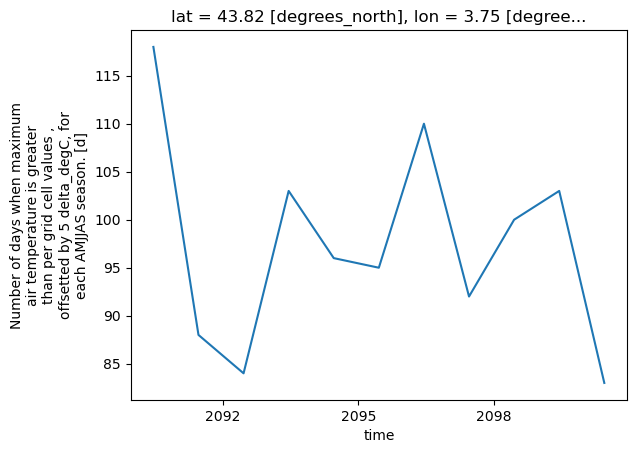
Subset and Plot TXND#
[11]:
# Slice the data spatially using a single lat/lon point
one_point = txnd.sel(lat=latitude, lon=longitude)

# Use xarray to create a quick time series plot
one_point.plot.line()
plt.show()
[12]:
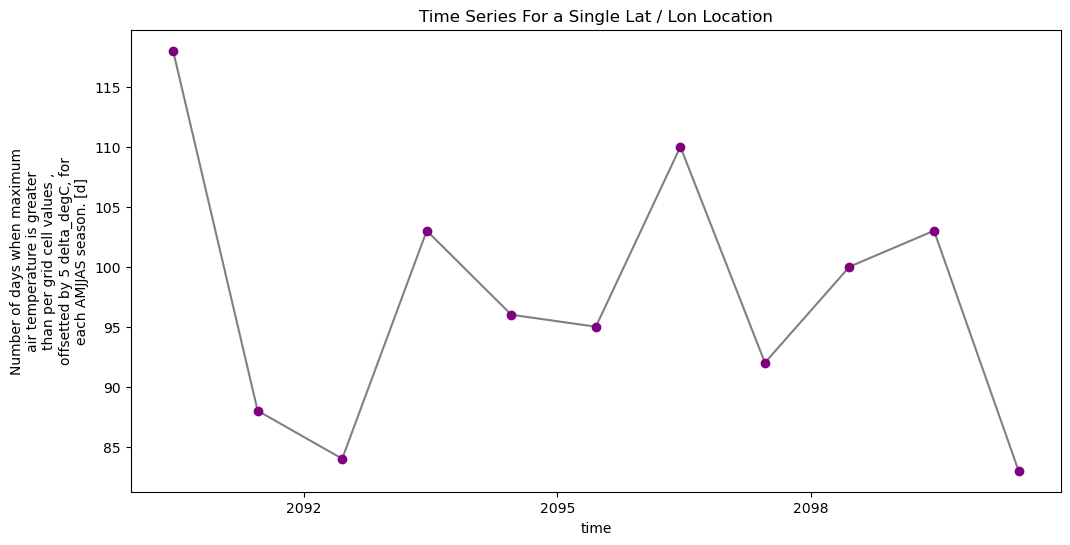
# You can clean up your plot as you wish using standard matplotlib approaches
f, ax = plt.subplots(figsize=(12, 6))
one_point.plot.line(
    hue="lat",
    marker="o",
    ax=ax,
    color="grey",
    markerfacecolor="purple",
    markeredgecolor="purple",
)
ax.set(title="Time Series For a Single Lat / Lon Location")

plt.show()
[13]:
# Convert to dataframe -- then this can easily be exported to a csv
one_point_df = one_point.to_dataframe()
# View just the first 5 rows of the data
one_point_df.head()

# Export data to .csv file
[13]:
| lat | lon | height | TXND | |
|---|---|---|---|---|
| time | ||||
| 2090-06-16 00:00:00 | 43.82199 | 3.75 | 2.0 | 118.0 |
| 2091-06-16 00:00:00 | 43.82199 | 3.75 | 2.0 | 88.0 |
| 2092-06-16 00:00:00 | 43.82199 | 3.75 | 2.0 | 84.0 |
| 2093-06-16 00:00:00 | 43.82199 | 3.75 | 2.0 | 103.0 |
| 2094-06-16 00:00:00 | 43.82199 | 3.75 | 2.0 | 96.0 |
[14]:
# Time subsetting: this is just an example on how to do it
start_date = "2050-01-01"
end_date = "2100-12-31"

txnd_filtered = txnd.sel(time=slice(start_date, end_date))
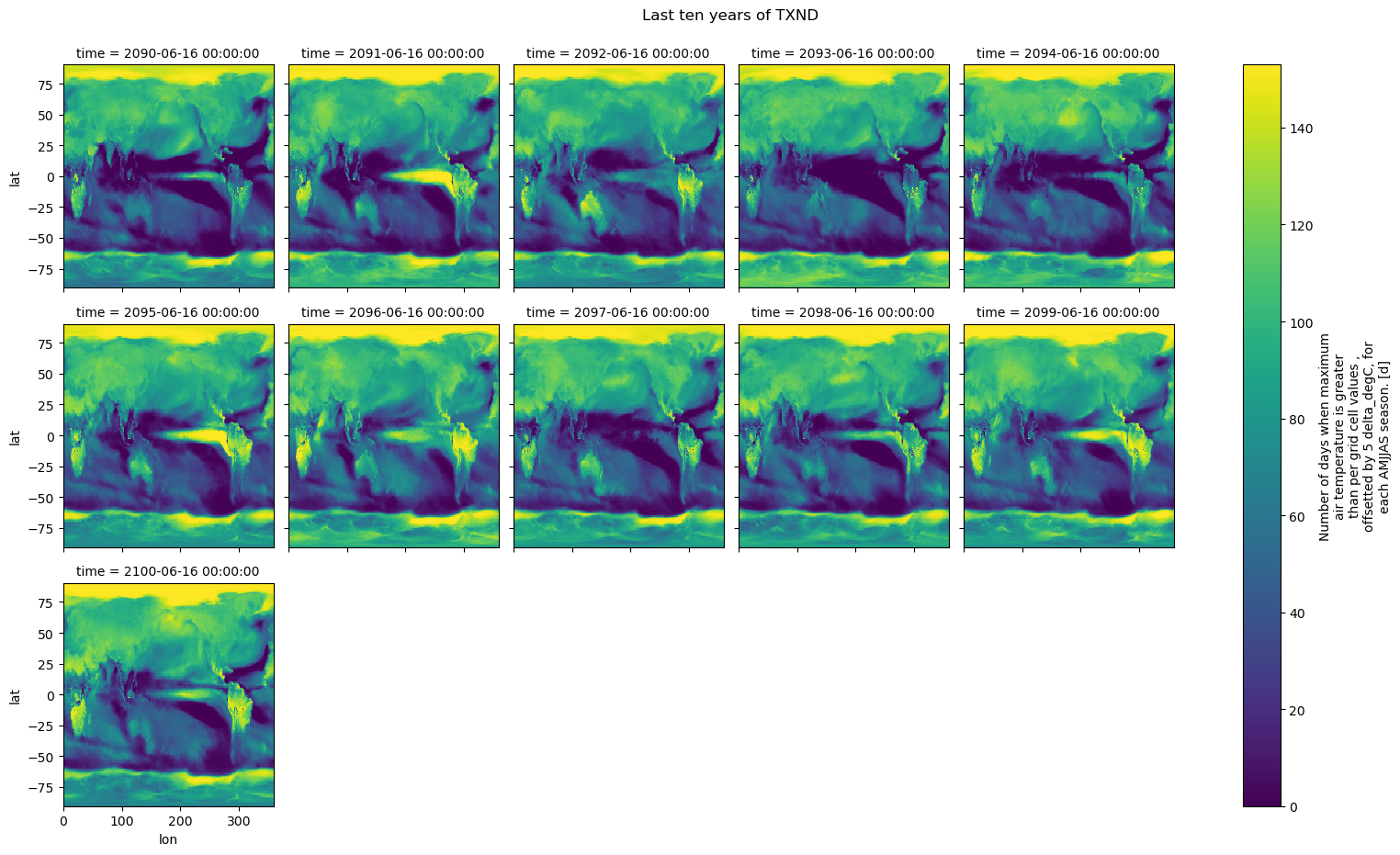
[15]:
# Quickly plot the data using xarray.plot()
txnd_filtered.plot(x="lon", y="lat", col="time", col_wrap=5)

plt.suptitle("Last ten years of TXND", y=1.03)
plt.show()
[16]:
# Set spatial extent and centre
central_lat = 47.0
central_lon = 1.0
extent = [-30, 30, 30, 56]  # Western Europe

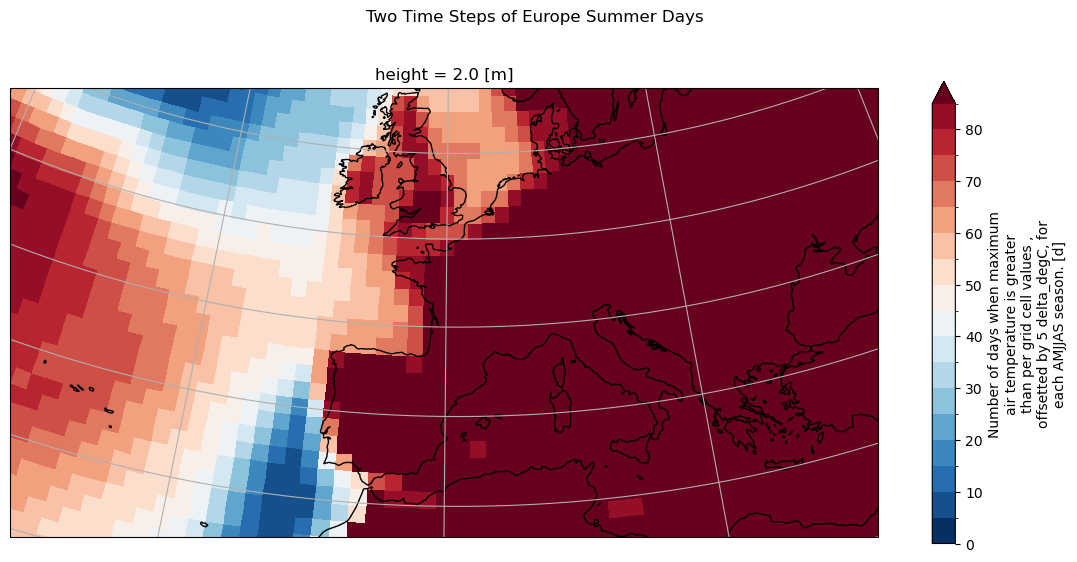
# Calculate time average
txnd_avg = txnd.mean(dim="time", keep_attrs=True)

# Set plot projection
map_proj = ccrs.AlbersEqualArea(
    central_longitude=central_lon, central_latitude=central_lat
)

# Define plot
f, ax = plt.subplots(figsize=(14, 6), subplot_kw={"projection": map_proj})

# Plot data with proper colormap scale range
levels = np.arange(0, 90, 5)
p = txnd_avg.plot(levels=levels, cmap="RdBu_r", transform=ccrs.PlateCarree())

# Plot information
plt.suptitle("Two Time Steps of Europe Summer Days", y=1)

# Add the coastlines to axis and set extent
ax.coastlines()
ax.gridlines()
ax.set_extent(extent)

# Save plot as png
plt.savefig("txnd_avg_icclim.png")
[17]:
# Re-order longitude so that there is no blank line at 0 deg because 0 deg is within our spatial selection
txnd_avg.coords["lon"] = (txnd_avg.coords["lon"] + 180) % 360 - 180
txnd_avg = txnd_avg.sortby(txnd_avg.lon)

# Define plot
f, ax = plt.subplots(figsize=(14, 6), subplot_kw={"projection": map_proj})

# Define colorscale
levels = np.arange(0, 90, 15)

# Contours lines
p = txnd_avg.plot.contour(
    levels=levels, colors="k", linewidths=0.5, transform=ccrs.PlateCarree()
)

# Contour filled colors
p = txnd_avg.plot.contourf(
    levels=levels, cmap="RdBu_r", extend="both", transform=ccrs.PlateCarree()
)

# Plot information
plt.suptitle("Two Time Steps of Europe Summer Days", y=1)

# Add the coastlines to axis and set extent
ax.coastlines()
ax.gridlines()
ax.set_extent(extent)

# Save plot as png
plt.savefig("txnd_avg_contours_icclim.png")
[ ]: